
Workplace safety cannot be viewed as an isolated obligation or as a set of procedures applied only when an incident occurs. In an industrial setting, prevention must be an integral part of the work culture itself, be incorporated into the planning of every task, and accompany teams throughout the entire course of a project.
In our business group, occupational risk prevention is an essential element in the execution of industrial work, installations, maintenance, and technical operations. Experience shows that proper risk identification, the appropriate use of protective equipment, and compliance with established procedures directly contribute to reducing accidents and creating safer work environments.
Prevention Begins Before Work Begins
An important part of safety is established before any work begins; inspecting the work area, checking the condition of tools, identifying potential obstacles, and ensuring that equipment is suitable for the task allows us to anticipate situations that could lead to accidents.
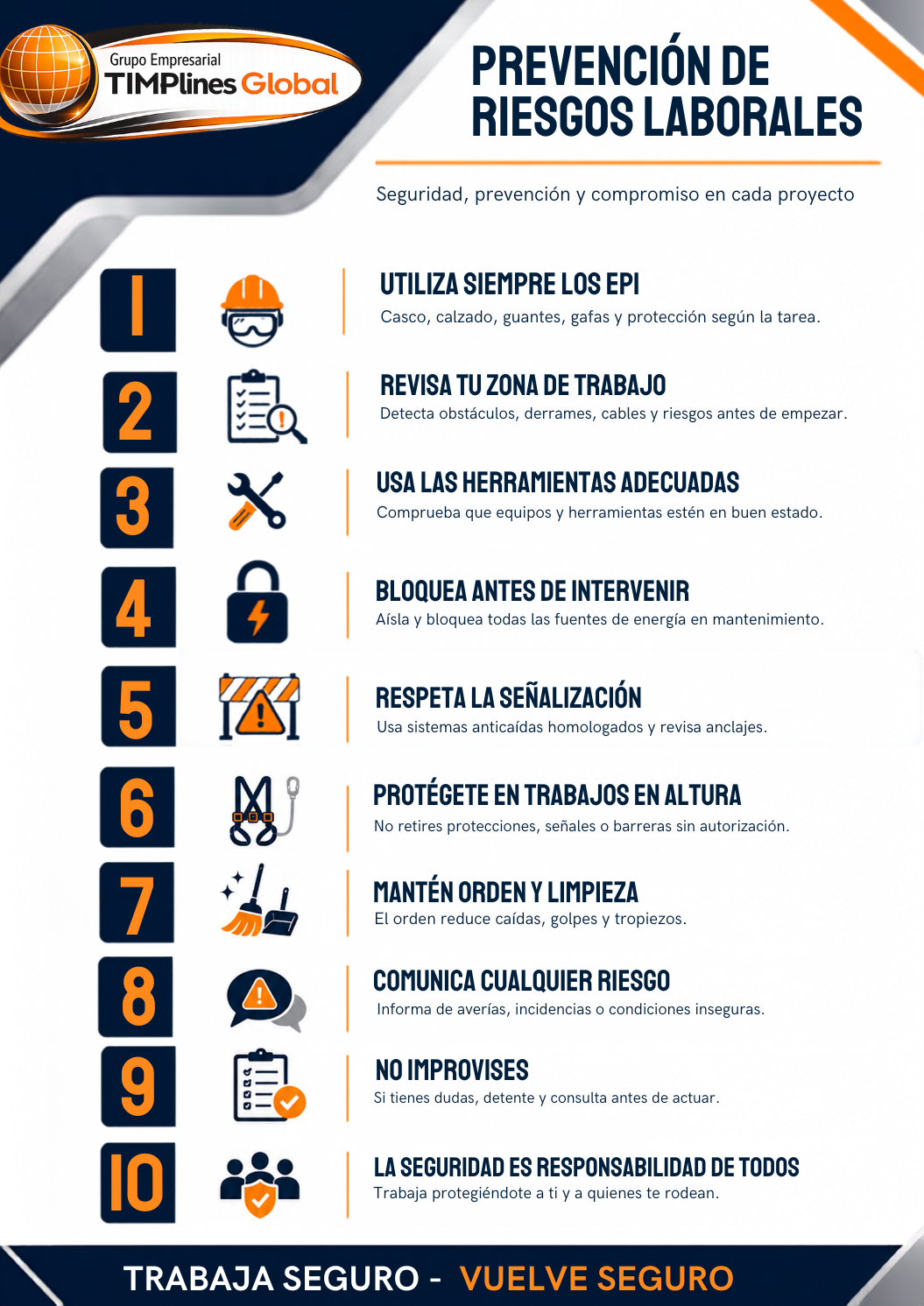
For this reason, the TIMPlines Global Business Group reminds its teams of the importance of incorporating a series of preventive habits into their daily work:
- Always use the appropriate personal protective equipment (PPE).
- Inspect the work area beforehand.
- Use appropriate tools and equipment that are in good condition.
- Shut off and isolate power sources before working on facilities or equipment.
- Always follow signage and respect existing safety barriers.
- Use certified fall-arrest systems when working at heights.
- Keep work areas tidy and clean.
- Immediately report any risks or unsafe situations.
- Avoid improvising and follow established procedures.
- Understand that safety is a shared responsibility of the entire team.
Safety also means communication
Prevention does not depend solely on equipment, signage, or technical procedures. Communication among the people involved in a project or industrial operation is equally important.
Reporting a malfunction, communicating a hazardous situation, or stopping a task when there are doubts can prevent an accident. Therefore, fostering a culture in which any worker can report an incident is part of responsible safety management.
A Shared Responsibility
Prevention is most effective when everyone involved in a project actively participates in it. Every professional has a responsibility to work safely, but also to help protect those around them; supervisors, technicians, operators, and project managers are all part of the same safety chain.
This philosophy helps create work environments where safety is naturally integrated into daily activities.
Work safely. Return home safely
Occupational safety is part of TIMPlines' commitment to professionalism, responsibility, and continuous improvement in all its projects.
Safety doesn't begin when an accident occurs; it begins long before that: in planning, in training, in the proper use of equipment, and in every decision made during the workday.